St. Polycarp
The early Church was not built on comfort, popularity, or political influence. It was built on witness. This week we turn to St. Polycarp, a bishop formed by the Apostles themselves and refined by persecution. His life connects us directly to the first generation of Christianity, reminding us that the faith we profess today is the same faith preached, defended, and sealed with blood in the second century. In a culture that often pressures believers to compromise, Polycarp’s steadfastness calls us back to clarity, courage, and unwavering fidelity to Christ.
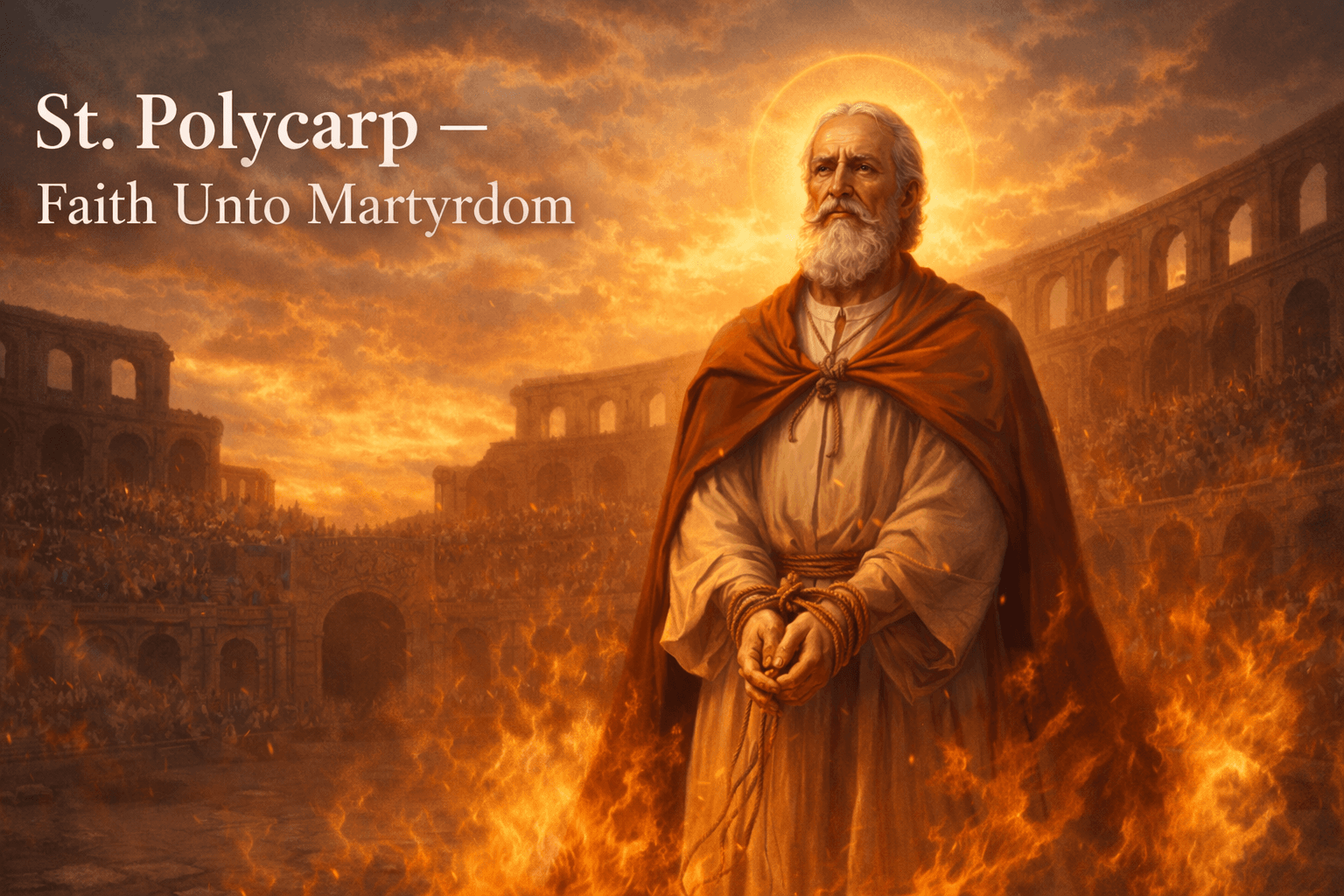
St. Polycarp, Bishop of Smyrna and disciple of St. John the Apostle, was one of the earliest Church Fathers. Arrested during Roman persecution, he was urged to renounce Christ. Instead, he boldly proclaimed his faith, declaring that he had served Christ for eighty-six years and would not betray Him. He was martyred around 155 AD.
Why it matters: Polycarp stands as a direct link to the Apostles and the earliest Christian witness. His martyrdom demonstrates steadfast faith under persecution and reinforces the historical continuity of apostolic teaching in the Catholic Church. His courage challenges modern believers to remain faithful amid cultural pressure.
The Martyrdom of Polycarp is one of the oldest surviving Christian martyrdom narratives outside the New Testament. It describes his arrest, trial, and execution, emphasizing his calm demeanor, trust in God, and refusal to curse Christ despite threats of wild beasts and fire.
Why it matters: This early document provides historical evidence of how the first Christians understood martyrdom—not as defeat, but as participation in Christ’s suffering. It reinforces Catholic teaching on redemptive suffering and witness, offering believers a model of spiritual resilience.
As a disciple of St. John and mentor to St. Irenaeus, Polycarp represents the living chain of apostolic succession. His role in defending orthodoxy against early heresies and preserving authentic doctrine was foundational to the Church’s theological development.
Why it matters: In an age of doctrinal confusion, Polycarp’s life highlights the importance of fidelity to apostolic teaching and Church authority. His witness affirms the Catholic understanding of succession, unity, and doctrinal continuity from the Apostles to today.
St. Polycarp forces us to confront a difficult question: what would it take for us to deny Christ? Social pressure? Professional consequences? Public ridicule?
In the second century, fidelity could cost you everything. Polycarp, formed by the Apostle John himself, did not defend Christianity as an abstract philosophy. He defended a Person. His final words were not theological arguments but a testimony of relationship: Christ had been faithful to him for eighty-six years. That loyalty shaped his courage.
Today, persecution in the West often looks different. It can be subtle silence instead of proclamation, compromise instead of clarity. Polycarp reminds us that holiness is not dramatic heroism but consistent fidelity over decades. His witness challenges us to remain anchored in apostolic teaching, united to the Church, and steadfast in truth regardless of cultural pressure.
Martyrdom is rare. Witness is daily.
May we serve Christ with the same unwavering conviction.
“Eighty-six years I have served Him, and He has done me no wrong. How can I blaspheme my King and my Savior?” - Saint Polycarp