St. Martin of Tours: Soldier of Mercy, Bishop of the Poor
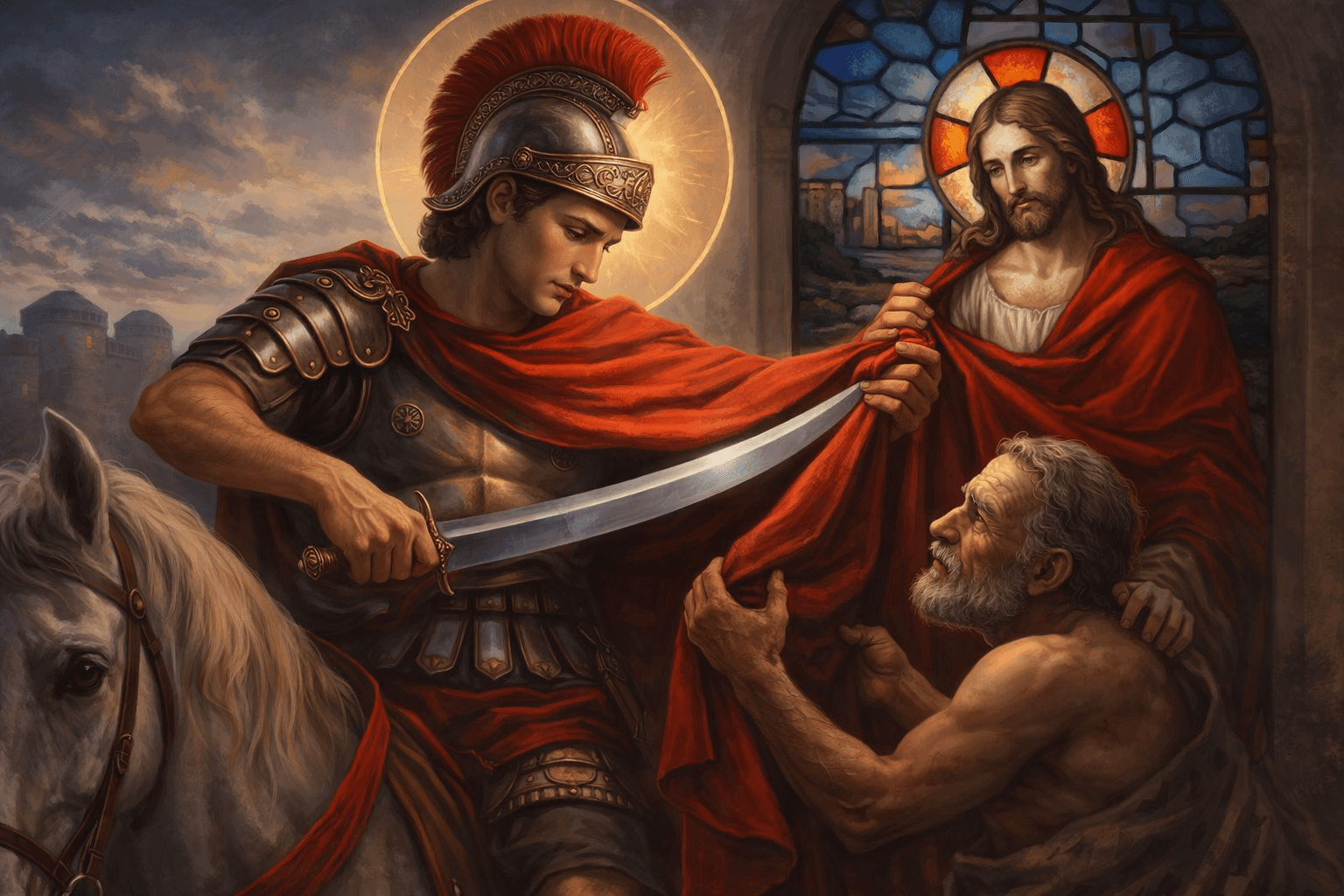
St. Martin of Tours is remembered not for military victory or theological treatises, but for a single act of mercy that changed the course of his life. As a young Roman soldier, Martin encountered a freezing beggar at the city gates of Amiens. With no money to give, he cut his cloak in half and shared it. That night, Christ appeared to him in a dream wearing the cloak, revealing that true greatness is found in charity.
Martin soon left the army, embraced the Christian faith fully, and eventually became Bishop of Tours. Despite his position, he lived simply, defended the poor, opposed violence, and became one of the earliest non-martyr saints to be widely venerated. His life reminds the Church that holiness often begins with ordinary compassion offered without hesitation.
This entry provides a detailed historical and theological overview of St. Martin of Tours, drawing from early sources such as Sulpicius Severus. It examines Martin’s military background, conversion, monastic life, episcopacy, miracles, and the development of his cult throughout Western Christianity.
Why it matters: The Catholic Encyclopedia offers one of the most rigorous and source-driven accounts of St. Martin’s life. It helps distinguish historical fact from later legend while showing why Martin became one of the most influential saints in Europe, shaping Christian views on charity, monasticism, and episcopal leadership.
Vatican resources reference St. Martin of Tours within the broader tradition of the Church’s saints, particularly in papal teachings, general audiences, and historical reflections on early bishops and evangelizers of Europe.
Why it matters: The Vatican’s treatment situates St. Martin within the living memory of the Church rather than as a purely historical figure. His example is consistently held up as a model of pastoral humility, courage, and Gospel-centered charity for bishops and lay faithful alike.
This article presents a concise, academically grounded biography of St. Martin of Tours, covering his early military service, conversion, monastic foundations, role as bishop, and long-term influence on European Christianity.
Why it matters: Britannica provides a neutral, scholarly perspective that complements ecclesial sources. It underscores Martin’s historical significance beyond devotion, showing how his life influenced social norms, religious institutions, and the spread of Christianity in post-Roman Europe.
This reflection highlights St. Martin’s most enduring legacy: radical charity rooted in humility. It recounts the famous cloak-sharing story and emphasizes Martin’s commitment to peace, simplicity, and service to the poor.
Why it matters: Franciscan Media bridges history and daily discipleship. By focusing on Martin’s compassion rather than his status, it invites modern readers to see charity not as an abstract virtue, but as an immediate and personal response to human need.
St. Martin of Tours challenges modern assumptions about holiness and success. He did not found a great theological school, write volumes of doctrine, or seek influence. Instead, his sanctity was forged in ordinary moments of moral clarity. Faced with a man in need, Martin chose compassion without calculation, and that single decision reshaped his life.
As bishop, Martin resisted the comforts and power typically associated with his office. He continued to live simply, defended prisoners, opposed executions, and worked to convert hearts rather than coerce them. His leadership was rooted in service, not authority, reminding the Church that shepherds are first called to imitate Christ’s humility.
In an age marked by distraction and excess, St. Martin’s witness feels especially relevant. His life teaches that charity is not an abstract ideal but a concrete action, often costly, always transformative. Holiness begins not in extraordinary visions, but in the willingness to see Christ in the poor, the cold, and the forgotten.
“Charity is the garment which covers a multitude of sins.” — St. Martin of Tours