St. Dimas: The Good Thief and the Promise of Mercy
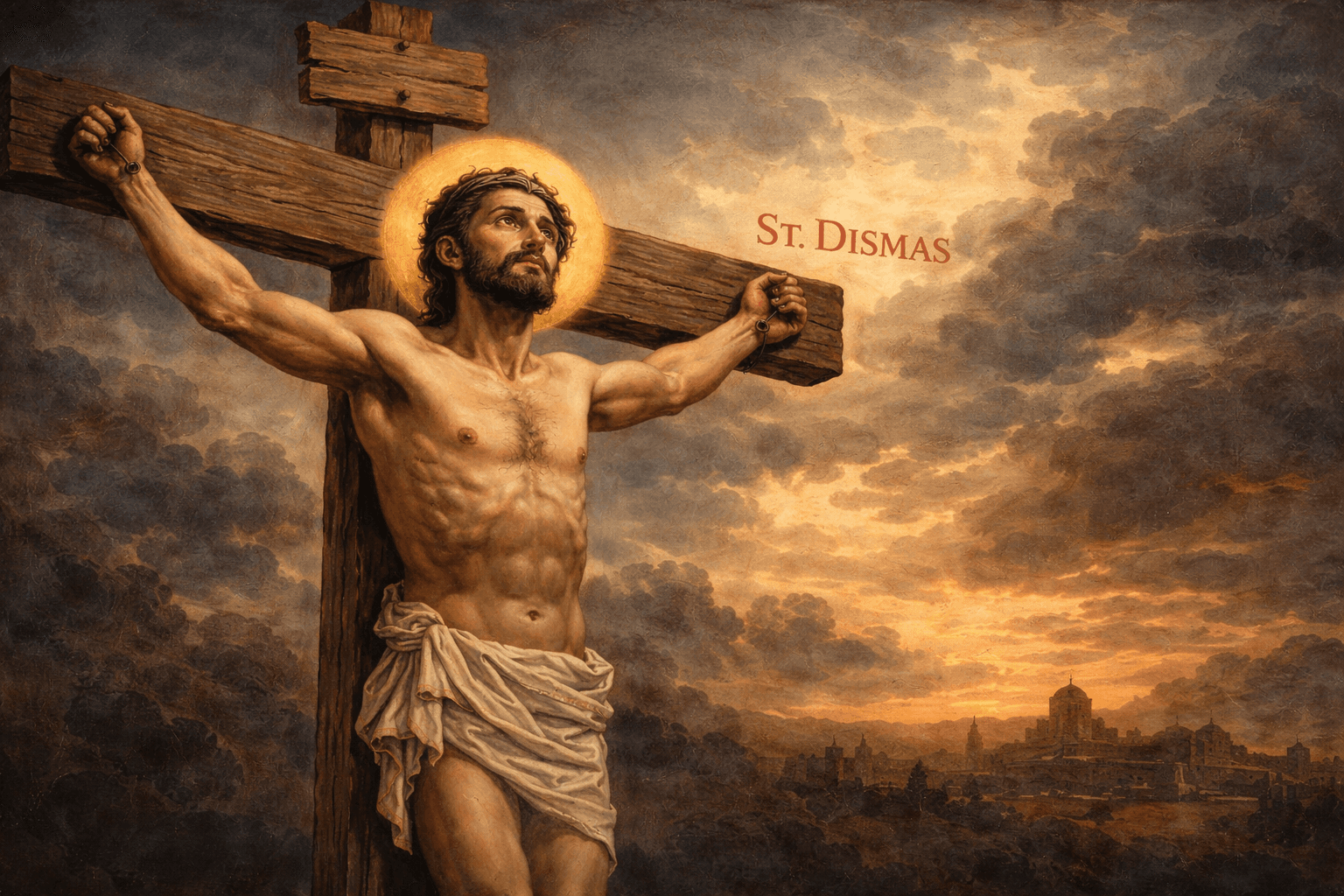
St. Dimas, traditionally known as the Good Thief, stands as one of the most powerful witnesses to Christ’s mercy in the Gospels. Crucified alongside Jesus, Dimas had no lifetime of visible holiness, no recorded miracles, and no opportunity to make restitution for his sins. Yet in a single moment of humility and faith, he entrusted himself completely to Christ. His story reminds us that no soul is beyond redemption and that God’s mercy is not limited by time, circumstance, or past failures.
According to the Gospel of Luke, while one criminal mocked Jesus, Dimas recognized both his own guilt and Christ’s innocence. Turning to Jesus, he uttered a simple but profound plea: “Jesus, remember me when you come into your kingdom.” Christ’s response was immediate and definitive: “Amen, I say to you, today you will be with me in Paradise.” In that moment, Dimas became the first canonized saint, declared holy by Christ Himself.
St. Dimas is a patron for those who feel unworthy, forgotten, or too far gone to be forgiven. His life and death proclaim a central truth of the Christian faith: salvation is a gift of grace, not a reward earned by merit alone. Especially during Lent, St. Dimas invites us to examine our hearts, acknowledge our need for mercy, and trust fully in the saving love of Christ.
The Gospel of Luke recounts the exchange between Jesus and the repentant criminal crucified beside Him. In a moment of sincere faith, the thief asks to be remembered, and Christ promises him eternal life.
Why it matters: This passage is the foundation of devotion to St. Dimas. It shows that salvation is granted through humility and trust in Christ, even at the final moment of life, reinforcing the Church’s teaching on mercy and repentance.
This entry provides historical and theological context for St. Dimas, including tradition surrounding his name, role in the Crucifixion, and early Christian veneration.
Why it matters: Understanding the tradition behind St. Dimas deepens appreciation for how the Church recognizes holiness not through a perfect life, but through genuine conversion and faith in Christ.
The Good Friday liturgy presents the Passion narrative, including Christ’s words to the Good Thief, inviting the faithful to meditate on sacrifice, forgiveness, and redemption.
Why it matters: St. Dimas is inseparable from the Passion story. This reading places his conversion within the Church’s most solemn liturgical moment, emphasizing that mercy flows directly from the Cross.
A Reflection on Last-Moment Faith
St. Dimas challenges a common misconception about holiness: that it is reserved only for those who live visibly righteous lives. His conversion did not come after years of discipline or public devotion, but in a moment of profound clarity. Facing death, he acknowledged his sins, defended Christ’s innocence, and placed his hope entirely in Jesus. This teaches us that repentance is not about timing but about sincerity.
The Good Thief also reminds us that despair is never justified. No matter how late the hour or how heavy the burden of sin, God’s mercy remains available. Christ did not ask Dimas for proof of reform or future good works. He responded to faith with a promise. In this way, St. Dimas becomes a sign of hope for all who fear it may be “too late” to return to God.
During Lent, or at any moment of personal struggle, St. Dimas invites us to pray with honesty and humility. His simple plea can become our own: to be remembered by Christ, to trust in His mercy, and to believe that even in our final moments, grace can transform everything.
“Jesus, remember me when you come into your kingdom.” — St. Dimas